Virgin Atlantic accelerates the introduction of zero emission flight to UK customers.
The technology needed for new, quicker ways to travel – including short-haul, vertical take-off aircraft – is one step closer to being developed. Virgin Atlantic, has joined a consortium to work on developing the technology needed to introduce Advanced Air Mobility (AAM) in the UK.
What is Advanced Air Mobility or AAM?
AAM offers a new form of travel that will mean it’s quicker and easier to travel into congested urban areas and across regions under-served by existing infrastructure. Virgin Atlantic and Vertical Airspace previously announced a partnership to pioneer zero-emissions short-haul air travel.
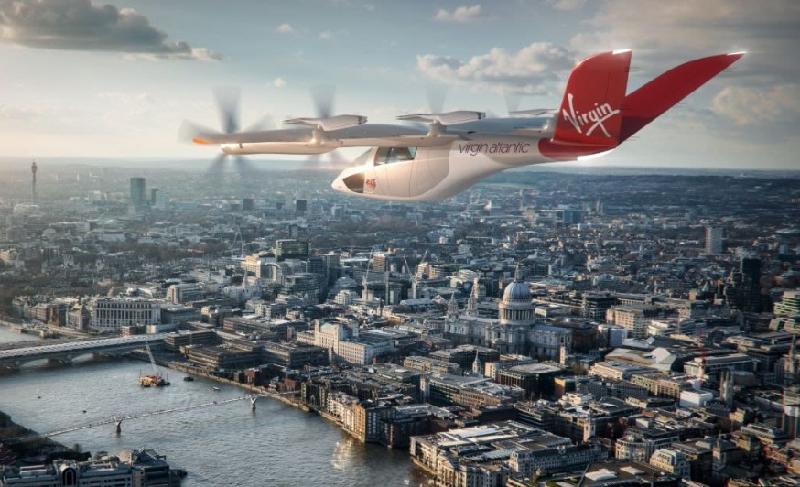
Vertical Aerospace is developing electrical Vertical Take-Off and Landing (eVTOL) aircraft that make virtually no noise and have a range of over 100 miles. The VX4 will carry four passengers plus a pilot. It has four tilting advanced rotors at the front and stowable rotors at the rear, making it capable of speeds over 200mph.
How is Virgin Atlantic Accelerating AAM.
Virgin Atlantic along with its partners Vertical Aerospace, Atkins, Skyports, NATS, Connected Places Catapult and leading academic institutions Cranfield University and WMG, University of Warwick, have announced the creation of the Advanced Mobility Ecosystem Consortium – which has been awarded a £9.5m grant by the UK government’s Future Flight Challenge.
The money will be used to develop a viable AAM ecosystem that could progress into commercial operations. The first-of-its-kind ecosystem will help accelerate AAM in the UK by creating and testing technological developments in aircraft electrification, airspace management, ground infrastructure, operational procedures, and the systems and supporting business cases needed to implement a new model of aerial passenger transport in the UK.
The Advanced Mobility Ecosystem Consortium is looking to demonstrate the feasibility of a UK AAM ecosystem using the VX4 aircraft, operated by Virgin Atlantic. Two flights will take place between Bristol Airport and an airfield in southwest England, and between London Heathrow Airport and the Living Lab vertiport – a testing facility that Skyports will build and operate. A third simulation flight will demonstrate urban connectivity between London City and Bristol airports.
These demonstrations will explore key aspects of the passenger journey, vehicle operation, airspace navigation, ground charging, security provision and local stakeholder engagement. The two-year project will be overseen by aerospace engineering experts Atkins, the consortium lead.
Duncan Walker, CEO of Skyports, said: “Just as airports are critical to commercial aeroplane travel, vertiports are critical to AAM. Our Living Lab will be a central component of the consortium, enabling Skyports and partners to demonstrate end-to-end operations and test the complexities of developing a commercially viable AAM network in the UK.”
Holly Boyd-Boland, VP corporate development at Virgin Atlantic, added: “We are thrilled to be working alongside our consortium partners to accelerate the introduction of zero emission flight to UK customers. As the only airline in the consortium, Virgin Atlantic brings 38 years of operational excellence, a relentless focus on safety and security, and an unrivalled focus on the end-to-end customer journey. Alongside our partners, we are looking forward to getting the first Virgin Atlantic eVTOL aircraft into the skies.”